Key Factors Influencing AC Furnace Replacement Costs in 2026
Replacing both your AC and furnace at the same time is generally recommended if the companion system is over 10 to 12 years old or incompatible with modern efficiency standards, saving 15% to 25% on combined installation labor. When budgeting for a full system upgrade, understanding the baseline figures helps you evaluate incoming quotes with confidence. Across the country, most residential change-outs range between $5,000 and $28,000 depending on your home’s layout, system complexity, and efficiency tier. However, the vast majority of standard split systems, combining a central air conditioner and a matched gas furnace, fall cleanly into the $9,500 to $17,000 installed range.
Several distinct variables drive these numbers:
- Equipment grade and build quality: Entry-level builder-grade equipment sits at the lower end of the cost spectrum ($7,000 to $10,500), while premium variable-capacity systems with advanced noise reduction and humidity control can reach $14,000 to $18,000 or more.
- Regional labor rates and accessibility: Labor accounts for 30% to 50% of your total project invoice. Billed technician rates typically run from $75 to $150 per hour nationwide, but local permitting requirements, difficult attic or crawlspace access, and regional wage differences can cause pricing to swing by plus or minus 15% between markets.
- Ductwork integrity: An HVAC system is only as good as the distribution network behind your walls. Standard replacement bids assume existing ducts can be reused. If an inspection reveals crushed runs, disconnected joints, or undersized returns, duct repairs or sealing can add $1,000 to $4,000 to the total scope of work.
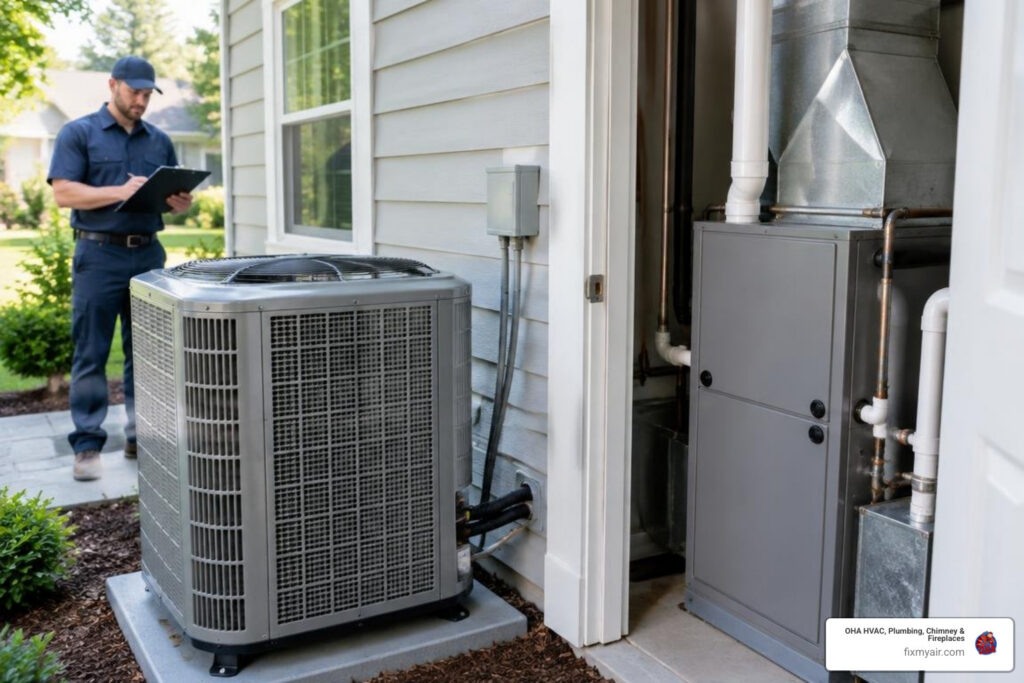
A well-planned HVAC installation starts with an airflow assessment, equipment match, and load calculation rather than a simple equipment swap.
How Sizing and Efficiency Impact AC Furnace Replacement Pricing
Bigger is not always better when it comes to heating and cooling equipment. Installing an oversized unit causes the system to “short-cycle,” turning on and off rapidly without running long enough to dehumidify your living space. This leads to clammy indoor air, uneven temperatures, and accelerated wear on critical parts.
System capacity must be determined through a professional Manual J load calculation. This calculation factors in your home’s square footage, window exposure, insulation levels, ceiling heights, and local climate data. Residential cooling capacity is measured in tons (typically 1.5 to 5 tons, where 1 ton equals 12,000 BTUs per hour of cooling), while furnace output spans 35,000 to 100,000+ BTUs.
Efficiency ratings directly influence both upfront equipment expense and your monthly utility bills:
- SEER2 (Seasonal Energy Efficiency Ratio 2): Measures cooling efficiency under updated testing protocols. Standard units range from 14.3 to 16.0 SEER2, while high-efficiency multi-stage or inverter units reach 18 to 22+ SEER2.
- AFUE (Annual Fuel Utilization Efficiency): Measures how much fuel a gas furnace converts directly into usable heat. Baseline units start at 80% AFUE, whereas high-efficiency condensing furnaces reach 95% to 98% AFUE and vent exhaust safely through PVC pipes rather than metal chimneys.
Higher SEER2 and AFUE combinations carry higher initial purchase prices, but mid-range packages, such as a 15.2 to 16 SEER2 AC paired with a 96% AFUE furnace, often offer a practical balance of upfront cost and lower utility use.
The 2026 Refrigerant Transition and Equipment Updates
The HVAC industry has transitioned away from R-410A refrigerant toward lower Global Warming Potential (GWP) alternatives, primarily A2L refrigerants like R-454B and R-32. While these refrigerants significantly reduce environmental impact, they operate under updated safety protocols.
Because A2L refrigerants are mildly flammable under specific laboratory conditions, modern indoor evaporator coils and air handlers now integrate active leak-detection sensors, automated shutoff valves, and revised electrical controls. These safety enhancements, alongside component tariffs and manufacturer pricing shifts, can increase the cost of new AC equipment compared with older systems.
You cannot run an A2L-charged outdoor condenser with an aging, incompatible indoor coil designed for R-410A. Attempting to mix generations risks pressure faults, coil freeze-ups, and voided manufacturer warranties. Replacing both the indoor coil and the outdoor unit simultaneously supports mechanical and chemical compatibility.
The Financial and Practical Benefits of Replacing Both Units Together
If your air conditioner is failing and your furnace is over a decade old, replacing them simultaneously is often the most economical path forward.
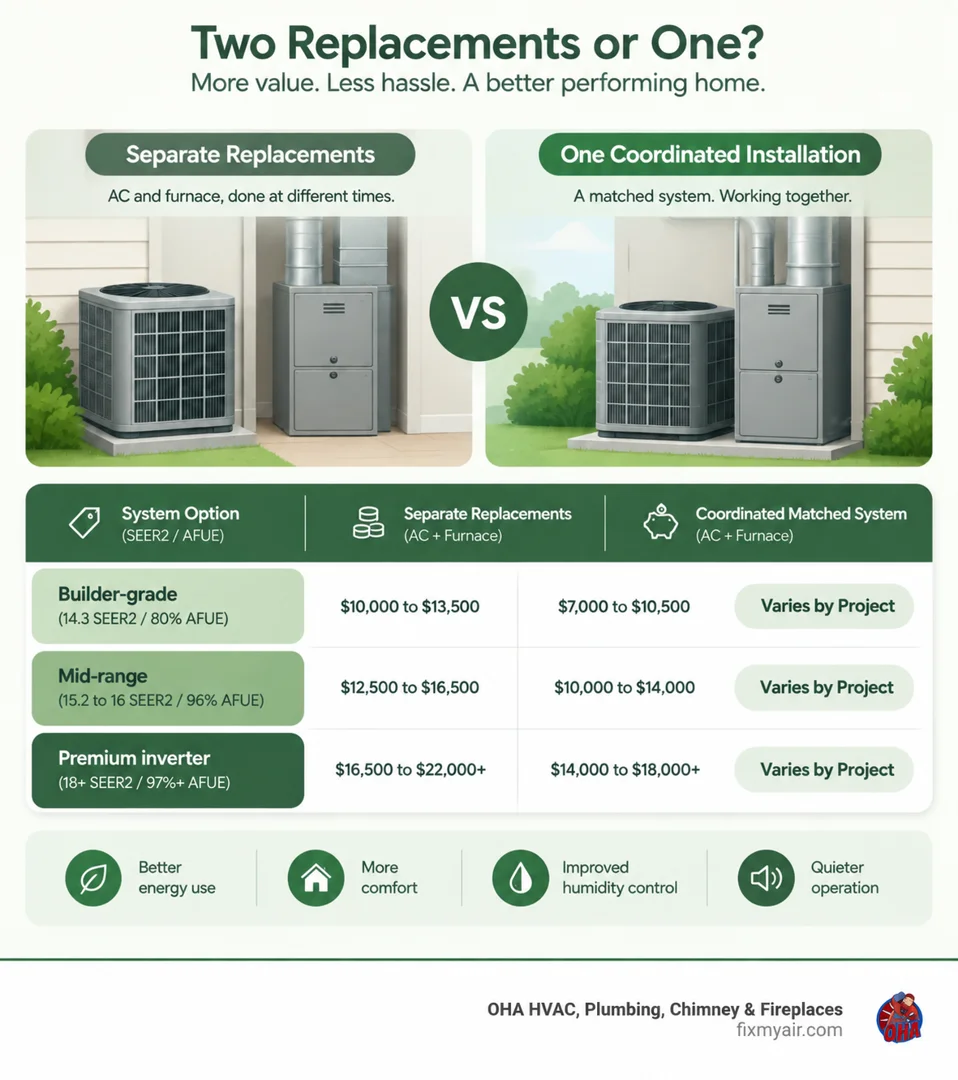
Bundling your heating and cooling equipment into a single project can reduce duplicated labor, administration, and project setup costs. Here is how the costs can compare across standard efficiency tiers:
| System Tier | Separate Replacements (AC then Furnace) | Bundled Replacement (Combined Project) | Average Homeowner Savings |
|---|---|---|---|
| Builder-grade (14.3 SEER2 / 80% AFUE) | $10,000 to $13,500 | $7,000 to $10,500 | Varies by Project |
| Mid-range (15.2 to 16 SEER2 / 96% AFUE) | $12,500 to $16,500 | $10,000 to $14,000 | Varies by Project |
| Premium inverter (18+ SEER2 / 97%+ AFUE) | $16,500 to $22,000+ | $14,000 to $18,000+ | Varies by Project |
Homeowners comparing a complete replacement scope can use OHA’s residential HVAC services to understand the system options available for their home.
A newer, matched system can also improve energy use, comfort, humidity control, and operating noise. The practical benefits of a new HVAC system are most noticeable when the equipment is properly sized and commissioned.
Labor Savings and Single-Permit Streamlining
Labor represents a significant share of any HVAC replacement bill. When you schedule an AC and furnace replacement together, you eliminate duplicate mobilization trips, setup fees, and recovery processes.
A crew replacing both systems at once can often accomplish the task in a single 8-to-10-hour workday. If scheduled as two distinct projects years apart, each installation requires separate staging, refrigerant recovery, electrical hookups, line-set flushing, and workspace teardown. Combining the two projects can reduce total labor hours by 15% to 25%, translating directly to upfront savings.
Municipal building departments may require permits and mechanical inspections for major HVAC installations. Doing both jobs together can mean one permit process and one building inspection rather than multiple administrative steps and appointments.
Matched System Performance and Warranty Alignment
Your central air conditioner and furnace are not entirely separate appliances; they operate as a unified split system. During hot summer months, your AC relies on the furnace’s indoor blower motor to push chilled air through your home’s ductwork.
If you pair a new high-efficiency 16+ SEER2 outdoor condenser with an aging 15-year-old furnace, the older single-speed blower motor can restrict airflow. This mismatch can reduce cooling efficiency, increase noise, and contribute to premature component wear.
Replacing both units delivers several operational advantages:
- Electronically commutated motors (ECM): Modern furnaces feature variable-speed ECM blowers that adjust airflow dynamically, maintaining consistent static pressure and quiet performance.
- Unified warranty coverage: Installing a matched system from a single manufacturer can help align component warranties and avoid compatibility questions if a problem occurs.
- Synchronized maintenance: Both units start fresh on day one, allowing your household to plan seasonal service on the same schedule.
Regular HVAC maintenance service helps keep a matched system operating efficiently and gives technicians an opportunity to catch airflow or performance issues early.
How to Decide: Replace Both or Replace Just One?
While bundling offers significant savings, there are scenarios where replacing only the broken unit makes practical sense. Evaluating the age gap between your components and using structured financial rules will guide you toward the right choice.
When to Schedule an AC Furnace Replacement vs. a Single Unit Repair
To determine whether a full system replacement is necessary, review the following guidelines:
Replace both units when:
- Both systems are over 10 to 12 years old: If your AC has failed and your furnace is 12+ years old, that furnace may already be nearing the end of its useful lifespan. Replacing only the AC can mean paying full labor costs now and again when the furnace fails a few years later.
- You are upgrading to a high-efficiency or multi-stage AC: Advanced cooling equipment may require a compatible variable-speed blower motor inside the furnace to achieve rated efficiency and proper dehumidification.
- You want to consolidate repair hassles: Bundling can help prevent recurring breakdown cycles, unexpected winter service calls, and disjointed repair warranties.
Replace only one unit when:
- The companion system is under 7 to 8 years old: If your furnace was replaced four years ago and remains in excellent mechanical health, there may be no reason to discard a functioning, efficient appliance.
- The existing equipment is fully compatible: Your technician can verify that the existing blower motor, line sets, and control boards match the new unit’s specifications.
- Short-term budget constraints dictate project scope: If an unexpected breakdown occurs and upfront funds are limited, replacing only the failed component may be the necessary path.
If an unexpected failure is the immediate concern, OHA’s AC repair services can help determine whether a repair, a single-unit replacement, or a full matched-system upgrade best fits the equipment’s condition.
Evaluating the $5,000 Rule and Equipment Lifespan
In the HVAC industry, technicians often use the $5,000 Rule as a quick guideline when weighing a repair against replacement.
Multiply the age of your system in years by the estimated repair cost in dollars:
- If the result is less than $5,000, repairing the unit may be reasonable.
- If the result is greater than $5,000, replacement is often the more practical financial choice.
For example, if a 14-year-old AC needs a compressor repair that costs $2,200:
$$\text{14 years} \times \$2,200 = \$30,800$$
Because $30,800 is far above $5,000 and the compressor is one of the system’s most expensive components, investing in a replacement may be the better long-term decision.
Keep standard equipment lifespans in mind:
- Gas furnaces: 15 to 25 years, depending on annual maintenance and heat exchanger condition
- Central air conditioners: 12 to 17 years, depending on outdoor coil exposure and compressor runtime
- Air-source heat pumps: 15 to 20 years
Frequently Asked Questions About HVAC System Replacement
Is it cheaper to replace an AC and furnace at the same time?
Yes. Bundling both replacements into a single project can save $500 to $2,500 compared with replacing each unit separately. These savings can come from shared labor hours, consolidated electrical work, line-set flushing, one permit process, and manufacturer equipment packages.
Are there federal tax credits available for HVAC upgrades in 2026?
No. The federal Section 25C Energy Efficient Home Improvement Credit expired on December 31, 2025, under the provisions of the One Big Beautiful Bill Act. As a result, 2026 installations do not qualify for direct federal tax credits.
However, homeowners may still find savings through state clean-energy initiatives, local electric and gas utility rebates for high-efficiency equipment, and financing programs offered by manufacturers and installers.
How long does a full system change-out take?
A standard full system replacement involves removing the old furnace, evaporator coil, and outdoor condenser, then installing, wiring, and commissioning the new matched system. It typically takes 8 to 12 hours.
A professional two-to-three-person crew can complete most straightforward change-outs within a single workday. If extensive duct modifications, custom sheet-metal transitions, or electrical subpanel upgrades are required, the work may extend into a second day.
Conclusion
Deciding whether to replace your AC and furnace at the same time comes down to system age, compatibility, and long-term value. While replacing a single unit requires a smaller immediate outlay, pairing an aging furnace with a modern high-efficiency AC can lead to performance bottlenecks, mismatched airflow, and duplicate installation bills a few years later.
By replacing both units together, you can support matched-system efficiency, align warranty coverage, and take advantage of single-mobilization labor savings.
At OHA HVAC, Plumbing, Chimney & Fireplaces, our veteran-founded, family-run team gives Northern Virginia homeowners transparent guidance, upfront pricing, quality craftsmanship, and 24/7 emergency support. Our background-checked technicians work together to recommend practical options based on your home’s needs.
Whether you need a Manual J load calculation, a diagnostic assessment, or a replacement estimate tailored to your home, contact our professional HVAC technicians to schedule a consultation.
Need Help With HVAC, Plumbing, Chimney, or Fireplace Service?
OHA is available 24/7 across Fredericksburg, Fairfax, and Northern Virginia.